Where are the Fathers?
Prodigals and the Kingdom

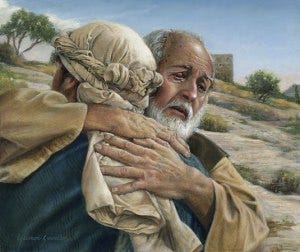
The old man sits in hushed silence, gazing with quiet intensity down the dusty road that stretches, forlorn and desolate, from home to horizon. His eyes, two shiny dark stones set in leather creased from long years laboring under the sun, are moist with tenderness and concern. He breathes softly, as he ponders, as he watches, as he scans the distance hoping that today might bring some news of the son he loved and lost such a long time ago.
He longs to see the familiar, bouncing walk of the boy he feels he no longer knows. The son who spurned his counsel and love, and instead went off his own way, to make his own way, to be his own man, free from constraint. The father still longs to see him, to hold him close and breathe in the fragrance of his hair, as he used to so many years ago. He longs for simply one more opportunity to look into his son’s eyes, and speak words of love and pride, affirmation of his joy in blessing his son as a young man. He fears that opportunity will never again come.
Then, he catches a glimpse of movement in the wavering distance. He recognizes a shape walking slowly toward him. The gait is different than before: slow and plodding, dust rising up behind shuffling feet; hunch of back and droop of shoulders speaking of dejection, loneliness, shame. A long walk, a return to a place necessary but feared.
The father barks a short, harsh-sounding cry. It is an old man wail cut short by his suddenly tightened throat; he forces his protesting legs to stand him upright. With unexpected vigor, he casts off his outer cloak and almost leaps from the entrance of his home to sprint down the road as his aching, aged legs propel him toward the figure of this son whom he has never stopped loving….
This is part of a story told twenty centuries ago by a master narrator: Jesus, son of Joseph. He was a carpenter turned itinerant preacher, who hailed from Nazareth, a small town in a nation ruled by the autocratic superpower Rome in the first century AD.
The tale is a poignant drama, made perhaps a little too familiar from endless retellings over the last two thousand years. Reading or hearing it in our day, we tend to miss just how thoroughly the father abandoned the cultural and social norms of that time. Rather than demand an apology, rather than stand and wait for his son to return in shame and apologize for his appalling disrespect and rebellion, the father instead disregards his own dignity and runs to the filthy, defiled, broken figure that the old man still loves, because he has never stopped hoping and dreaming for the return and restoration of his son.
Our western culture today is filled with young people who are like that son. Unnoticed, unwanted, angry and lost, adrift in a morass of confusing, conflicting ideologies spread before them by a society obsessed with power and greed. They look for wisdom, and find instead the festering putrefaction of men clawing and grasping for influence, wealth, and self-indulgence.
(I am not ignoring or excluding the need for mothers as I write this; but since I am a man, it seems more appropriate for me to call other men to account.)
A true father loves those who are under his care. A true father provides wise guidance, protecting love, responsible discipline, nurturing admonition, selfless encouragement. A true father finds no greater joy than seeing his children flourish in all areas of their lives. A true father will lay down his life for those who come after him. A true father follows the loving example of the Father of us all.
I have been in dozens of leadership positions in churches and ministries over the years. I am a leader in the church body I currently attend. Too many of us leaders have a really poor track record when it comes to behaving like God.
In writing this, I am painting with an extremely broad brush, and not giving due credit to the thousands of humble, godly men and women who have served faithfully and beautifully in leadership roles. Unfortunately, too often in decades past, believers have experienced insecure leaders seeking to advance their own kingdoms at the expense of others. There was so much jockying for position and power. Many young men and women, desiring to know God and his goodness, instead often saw petty jealousies, greed, and self-centeredness displayed by older people who should know better—who should be seeking to “do justice, love mercy, and walk humbly with their God” (Micah 6:8).
Things are changing in the western church—the change is occuring slowly, but it is happening. I take heart as I think of many conversations I have had the past several years with men of my generation (I was born in 1958; you do the math). We recognize our failure and understand our need to change, to learn how to bless the younger generations and offer our wisdom graciously with the intent to encourage and strengthen them.
When we do not do this; when any of us are more interested in establishing our own little kingdom than joining with the generations around us, adventuring together for the great purpose of seeing God’s kingdom advance “on earth as it is in heaven,” then the Lord says the following:
“You say, ‘I am rich; I have acquired wealth and do not need a thing.’ But you do not realize that you are wretched, pitiful, poor, blind and naked. I counsel you to buy from me gold refined in the fire, so you can become rich; and white clothes to wear, so you can cover your shameful nakedness; and salve to put on your eyes, so you can see” (Revelation 3:17-18).
We desperately need eyesalve, so that the eyes of our hearts can be enlightened and we can repent.
If you are reading this, and are a young man or woman who has been hurt by abusive or neglectful leaders, I ask you to forgive us, and do not give up! Many of us long to work with you and work for you and for the generations yet to come, in order to see you succeed and advance the kingdom of God in the midst of your generation. Press in to know the Lord and you will make a difference!
Do everything without grumbling or arguing, so that you may become blameless and pure, “children of God without fault in a warped and crooked generation.” Then you will shine among them like stars in the sky (Philippians 2:14-15).
If you are a leader, a man or woman with years of experience, I offer a simple exhortation: Learn to love well. Learn to be gracious in your wisdom and counsel as you offer help and direction. Learn to lead the way Jesus taught us: By laying down your life for the sake of the sons and daughters who will follow us.
But Jesus called them to Himself and said, “You know that the rulers of the Gentiles lord it over them, and those who are great exercise authority over them. Yet it shall not be so among you; but whoever desires to become great among you, let him be your servant. And whoever desires to be first among you, let him be your slave—just as the Son of Man did not come to be served, but to serve, and to give His life a ransom for many.” (Matthew 20:25-28).
“You call Me Teacher and Lord, and you say well, for so I am. If I then, your Lord and Teacher, have washed your feet, you also ought to wash one another’s feet.” (John 13:13-14).
Do nothing out of selfish ambition or vain conceit. Rather, in humility value others above yourselves, not looking to your own interests but each of you to the interests of the others. (Philippians 2:3-4).
Any other posture is a travesty that dishonors our Lord.